
A study in softness, time, and quiet construction
by KatyTricot Knits
A Sweater Knitted Over Time
Hello there 💙
It’s been a while since I’ve shared something here… but I’ve been knitting all along.
And one design, in particular, kept coming back to my needles over the years.
The SERENA Sweater.
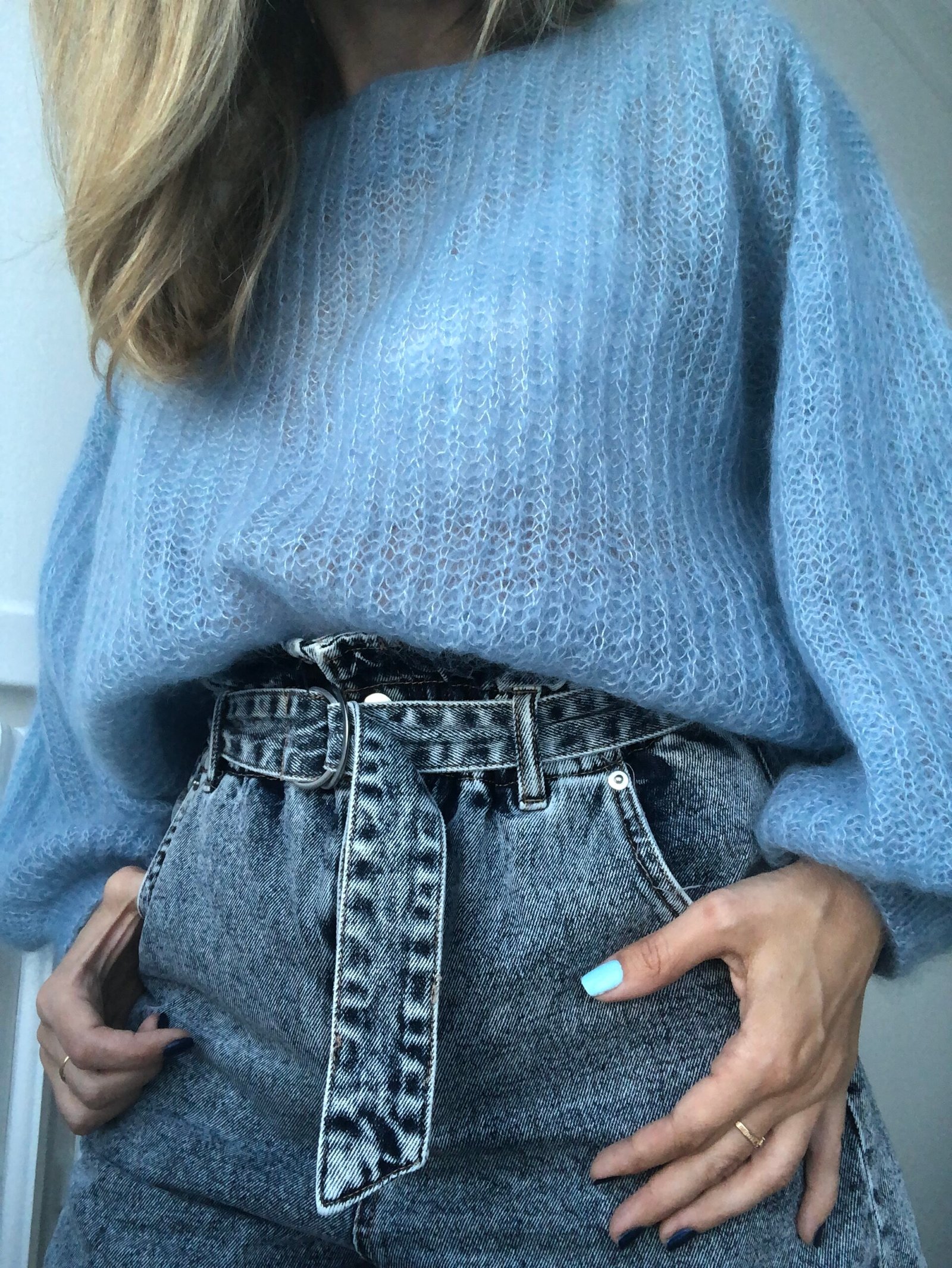
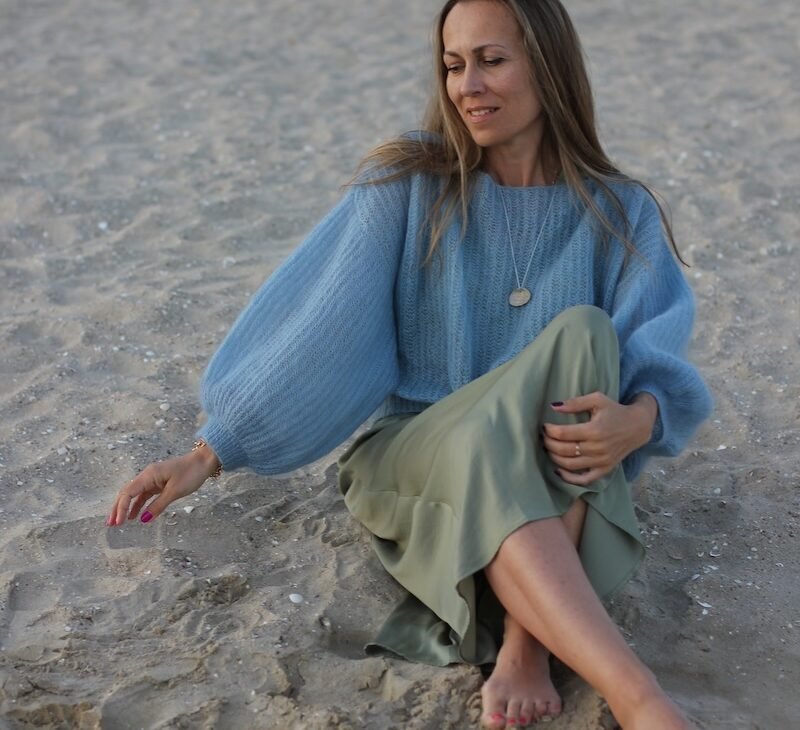
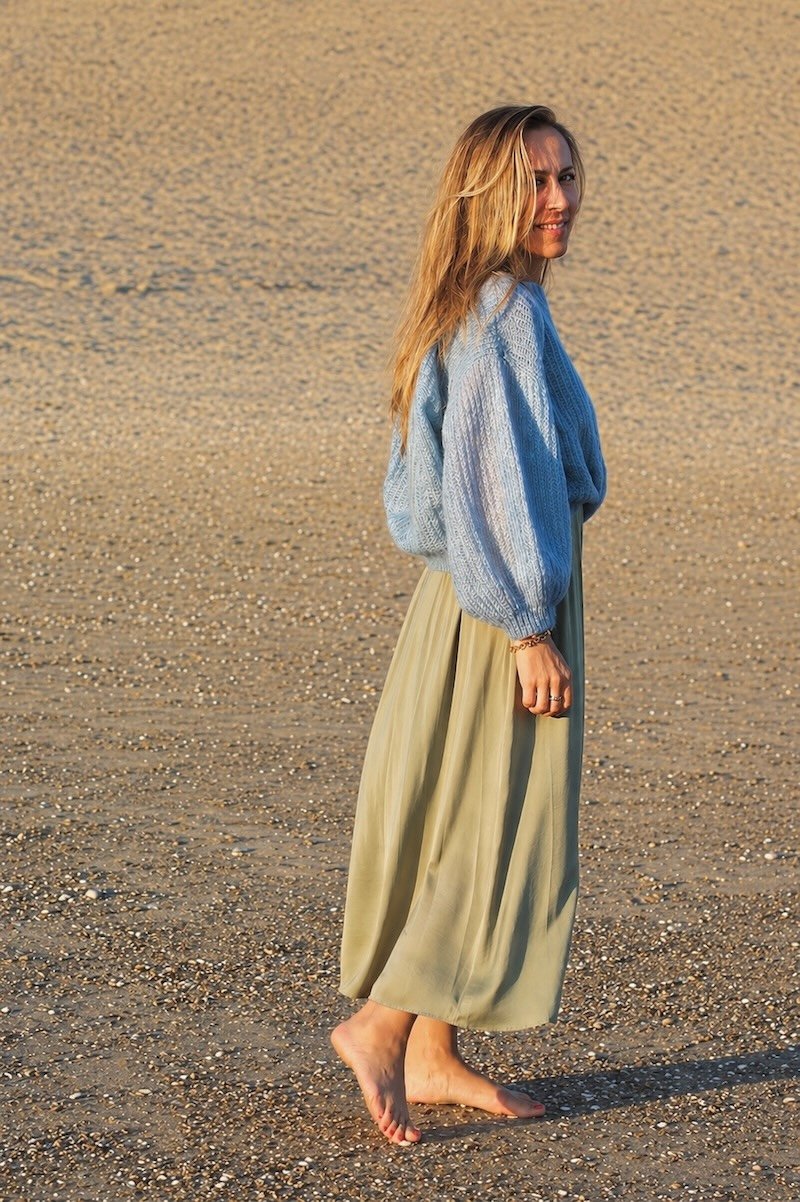
It all started in 2020, with a soft sky-blue mohair version — light, airy, almost like a cloud and a simple idea — to knit something soft, almost weightless.
Since then, it has followed me through the years, returning to my needles in different forms, each time a little familiar, a little new.
☁️ Like a cloud
At the time, I was drawn to lace-weight mohair — not for lace, but for its ability to create something almost immaterial. The first Serena was knitted in a soft sky-blue mohair and silk blend — Kid-Silk by Drops. I still remember the sensation of working it:
- the yarn barely touching the needles
- the stitches opening into soft, elastic columns
- the fabric forming something that felt more like air than structure
That first sweater weighed only 127 grams. And yet, it held its shape. It draped. It moved. It lived. That contrast — structure within lightness — became the foundation of the design.
Why brioche
To achieve this balance, brioche stitch became essential.
Not decorative brioche, not complex motifs —
but one-color brioche, in its simplest form.
Because brioche does something unique:
- it creates depth without density
- it traps air while remaining breathable
- it builds vertical columns that move with the body
In mohair, these qualities are amplified.
The halo softens every line.
The fabric becomes less defined, more fluid.
What could be graphic in wool becomes subtle and atmospheric in mohair.
A second life — knitting for my daughter
After the first version, the sweater didn’t disappear.
It stayed with me — not as a finished design, but as something I wanted to return to.
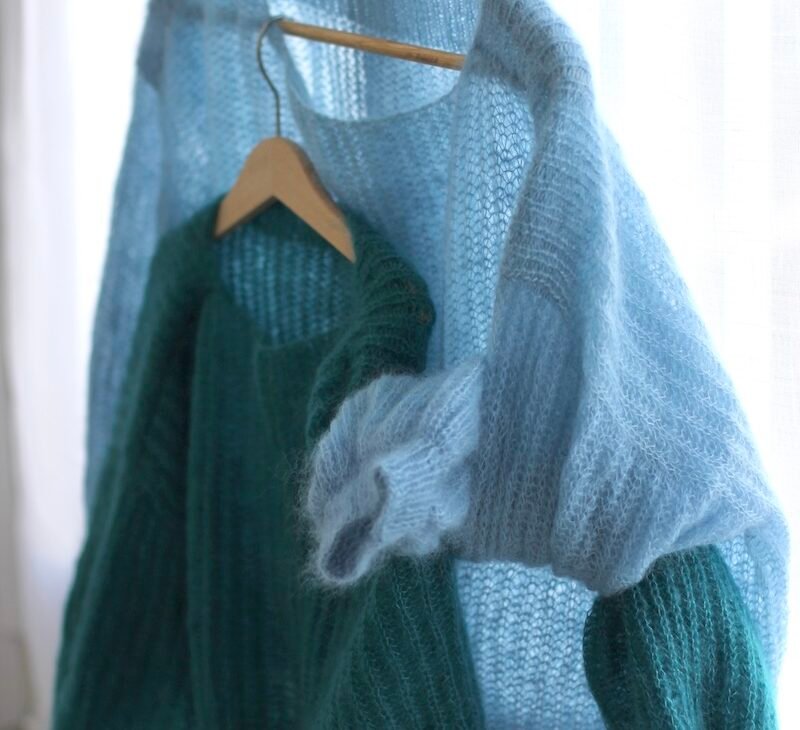
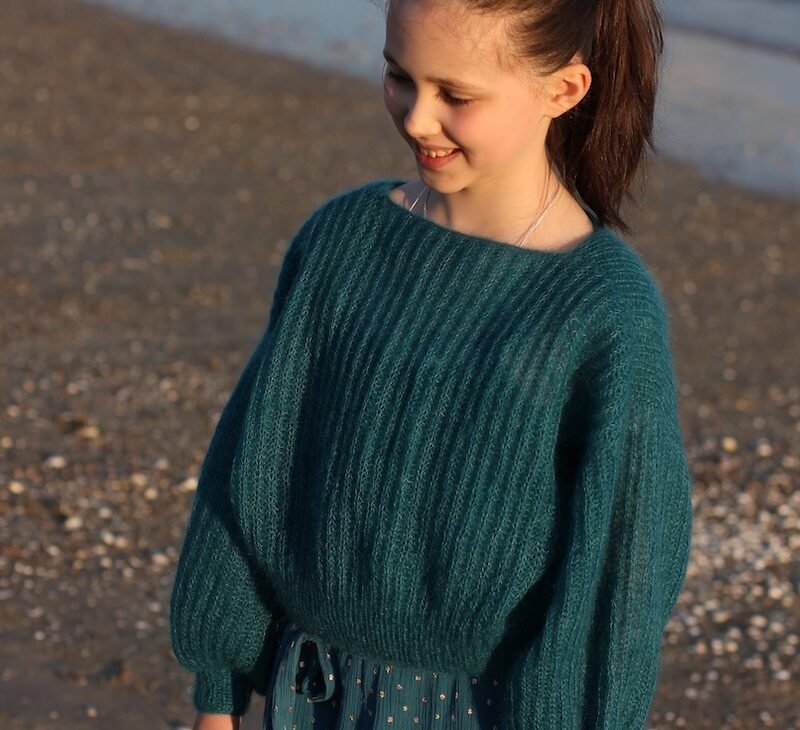
The next interpretation was much smaller: a version for my daughter.
Knitted in a deep teal tone, it carried the same structure but a different presence:
- softer, more enveloping
- closer to the body
- almost protective in feel
Seeing the design at a different scale changed how I understood it.
It wasn’t just about lightness anymore.
It was about comfort, familiarity, and ease of wear.
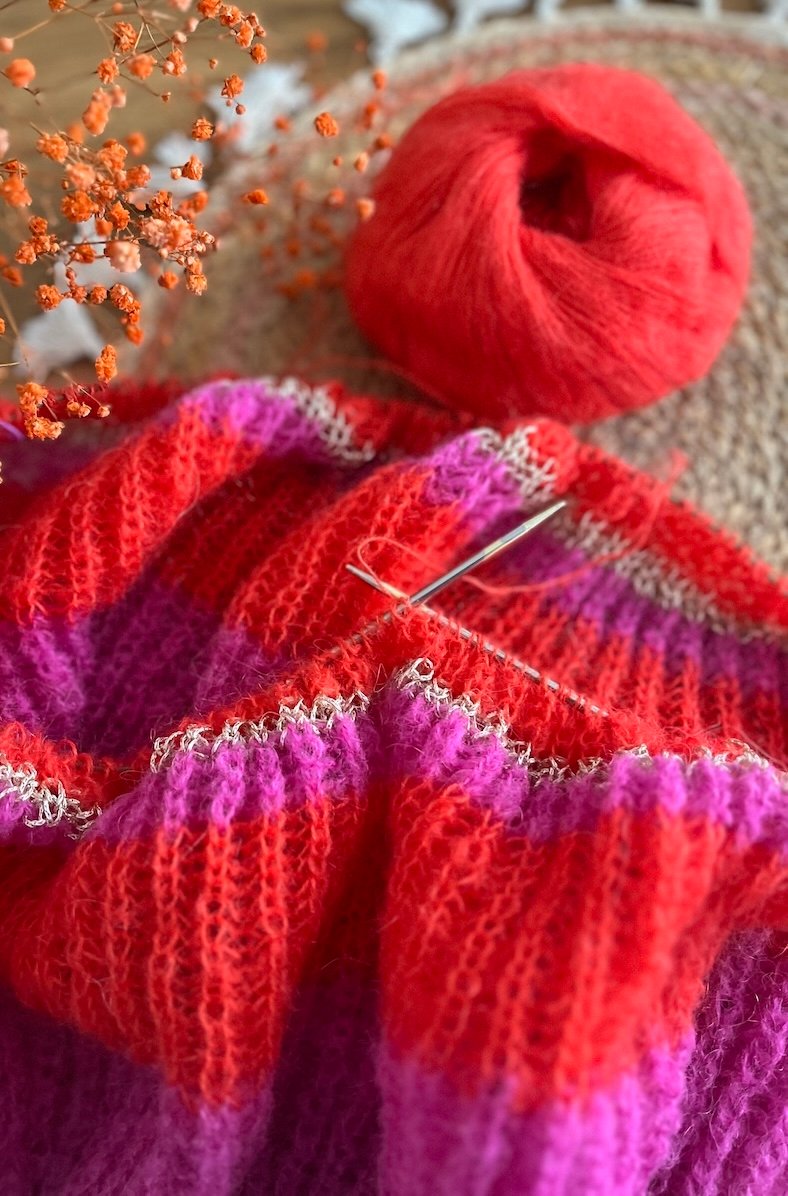
The striped version — working with what is already there
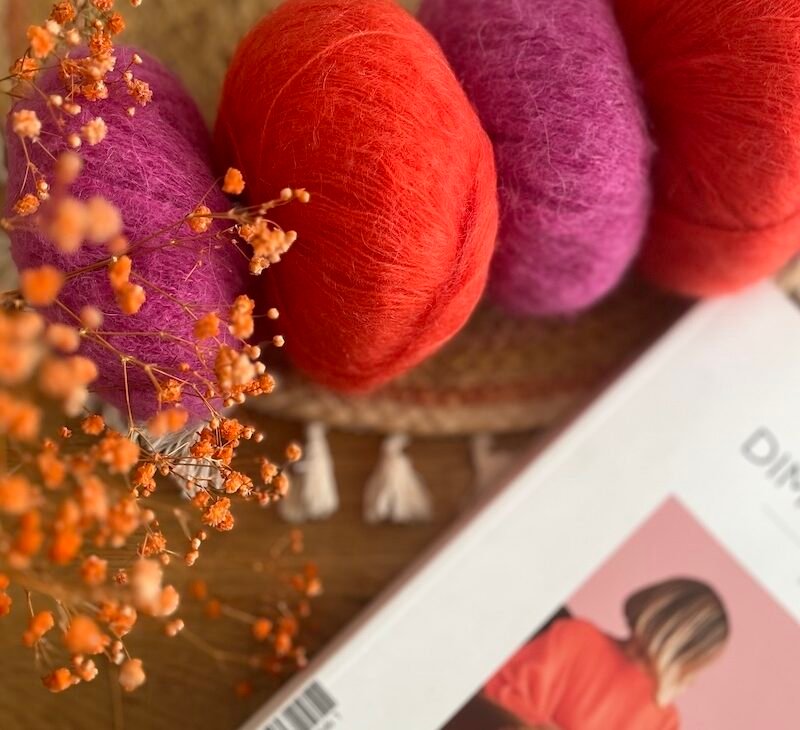
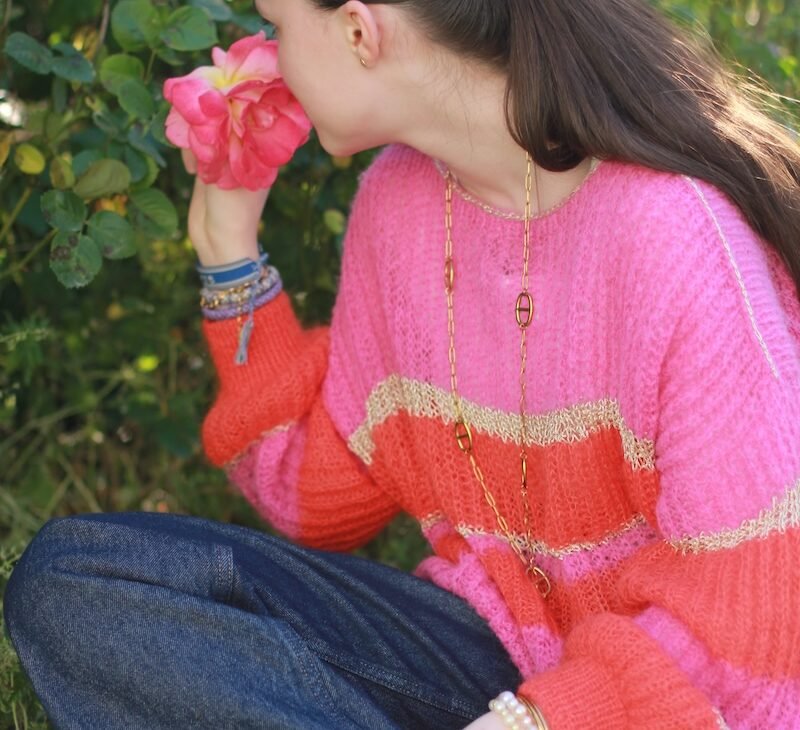
Last year, the sweater took another turn. This time, I didn’t start with a specific yarn in mind. Instead, I looked at what I had — a few leftover single balls, waiting to be used. The striped version was born from that.
- Vibrant fuchsia — Melody by Drops
- Bright orange — Softine by Cheval Blanc
- paired with touches of soft gold
It was a completely different expression of the same structure.
More playful.
More spontaneous.
And deeply satisfying in a different way.
This version reminded me of something essential: that design is not only about creating something new, but also about re-seeing what already exists.
📏 Stripe Planning Formula
1 main color + 1 accent color + 1 separator color
Suggested proportions
- Main color: ~55–65% of total length
- Accent color: ~30–40%
- Separator color: ~5% (used sparingly between sections)ows
Stripe size guide (in Brioche rows)
- Main color: worked throughout the entire yoke, then in larger sections of 16–26 rows
- Accent color sections: typically 12–14 rows
- Separator stripes: 3–4 rows
Brioche stitch softens color transitions, so slightly larger stripes will give a clearer visual result. Step back from your work occasionally — trust your eye more than the numbers. There’s no single right way to place the stripes — let your yarn and your mood guide you ✨
Working one-color brioche
For knitters, Serena offers a particular kind of experience.
One-color brioche can seem technical at first —
with its yarn overs, paired stitches, and two-row rhythm.
But once understood, it becomes something else entirely:
- repetitive
- grounding
- almost meditative
A sequence of movements that repeats, slowly building the fabric.
This sweater was designed to let that rhythm unfold without interruption.
(I’ve included a short video below to show how I work one-color brioche stitch.)
🧩 Construction — simplicity as a framework
From a technical perspective, Serena is deliberately restrained. It is worked top-down, allowing the fabric to develop naturally.
The structure relies on:
- drop shoulders, for a relaxed and fluid silhouette
- straight body and sleeves, without shaping
- a single decrease round at the cuffs, to gather the volume
- 1×1 rib worked with two strands, bringing firmness and contrast
There is no complex shaping. Instead, the form emerges from:
- proportion
- fabric behavior
- and the interaction between textures
Brioche expands. Rib contracts. And between the two, the silhouette finds its balance.
Wearing Serena
Serena is not a heavy sweater.
It doesn’t insulate in the traditional way.
It doesn’t define the body sharply.
Instead, it offers:
– a soft layer of warmth
– a sense of light protection and a feeling of ease
It works beautifully:
– on breezy summer evenings
– layered through early autumn
or simply indoors, as a comforting presence.
It is a garment that stays close without weighing you down.
A design that stayed
Looking back, Serena is not just a pattern. It is a design that has followed me through years, through different materials, scales, and moods. A piece that adapted, without losing its essence. And perhaps that is what I value most in it: not that it is perfect, but that it is alive — returning, evolving, and remaining relevant in its simplicity.
If you choose to knit it, take your time with it. Let the rhythm settle. Let the fabric grow. That is where Serena truly begins ✨
Warm hugs and soft yarns,
Katy ✨


Leave a Reply